

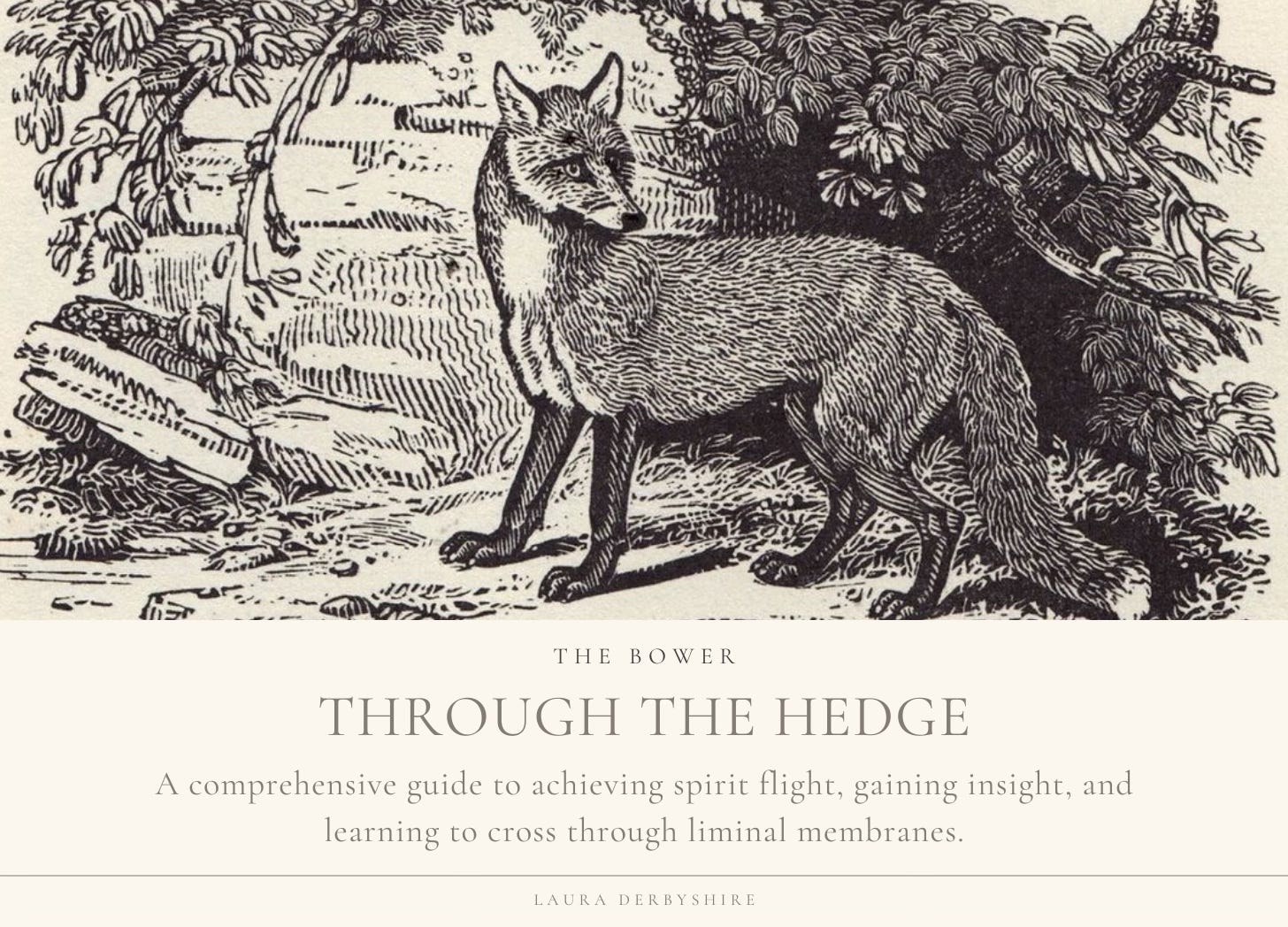
Whilst on your witchy travels I’m sure you have come across the term ‘hedge witchery’ lots of times, I know that I did when I was first researching my craft nearly fifteen years ago. If you have heard of hedge witchery then you have also come across the term ‘hedge riding’.
I find that hedge riding is a name that is often used in occult spaces but doesn’t really offer up a detailed explanation, when I was studying the ‘type’ of witchcraft that resonated with me the most hedge riding was a term that was either casually dropped into conversation or referenced weakly in written guides, as if the writer assumed that everyone already knew what it meant. Much that is written about hedge witchery sits at either end of the two extremes, at one end the explanations are so vague you can’t possibly do anything with them, and at the other end the explanation is so wrapped up in ceremonial language and secrecy that it fails to explain or capture the essence of what a strange practice it is.
Enter my attempt to explain what hedge riding, or spirit flight, is. I’ll do my best to throw some light on its origins and how people may have achieved it. You may think it a bit dull to look at the history (and the science) of it but it really does help us to understand it in a broader context, I spoke about the importance of researching multiple subjects in order to become a better practitioner here. We aren’t just witches here on The Bower, we’re also amateur historians, philosophers, horticulturalists, and a myriad of other interesting subject seekers. For those of you just here for present-day knowledge, don’t worry, we will also take a look at how to travel, why we should do it at all, and do a bit of troubleshooting, but ultimately I’ll be sharing with you my experiences, what I have learned, and what I would never do again. Experience is the best thing that one witch can offer another, but before we even think about that I have to explain what ‘the hedge’ actually is…
The Hedge:
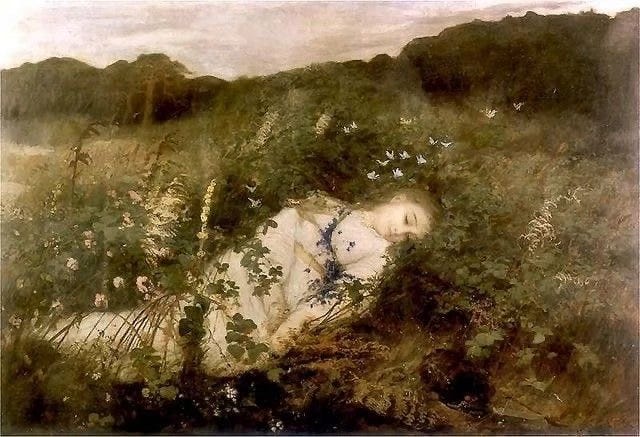
The hedge is what we witches call the liminal boundary between the very physical world that we inhabit, and the lesser-known Otherworld. There is a sort of membrane between them both that stretches, thins and thickens, ebbs and flows throughout the year, and it is the hedge witch that makes it her business to know how to traverse and work in them both. Historically a hedge witch was a ‘cunning woman’, a wise woman who lived on the edge of villages and towns, not within their borders but close enough on the outskirts to be called upon if needed.
’Riding the hedge’ is the name we give the act of spirit flight, of crossing the boundary, it is a curious blend between shamanic trance and lucid dreaming, but I believe that the ‘travelling’ or state you are in can look very different amongst practitioners.
I do not particularly feels that it belongs in the astral projection genre of travel, nor do I believe it is any sort of guided meditation or past life regression… it feels very much older, and definitely not like you are visualising or imagining it. It is an incredibly special practice, and one that I wish more witches felt confident enough to do…
(One thing I want to touch upon before inviting you to read further is this: this practice involves deliberately loosening the grip that you have on our ordinary reality. For most of us the loosening is temporary and intentional, but if your relationship with reality is complicated (so if you have ever experienced dissociation, or psychosis) then hedge riding might not be the best practice for you to pursue. This is in no way a judgement, and I am not trying to withhold an experience or exclude any group of people, I am just the sort of practitioner who wants to make sure that those who are learning from me stay safe. The practice is completely safe for people who are very grounded, but it is demanding, make sure your grip on reality is secure before you step through.)
The History:
This sort of practice is by no means a modern invention, it appears in many cultures in different ways, shapes, and forms, in fact we shouldn’t really be asking whether or not our ancestors crossed the hedge, but rather how they did it and why.
Of course we need look no further than Nordic traditions where a lot of European magickal practices hail from, and where we get some of our surviving documented material culture. Seiðr (pronounced Say-der) was a form of sorcery, a magickal practice that belonged to Nordic folk and had links to Freyja and Odin, it was a tranced-based practice involving the Volva, or wand-bearers, who were the central figures of this tradition. Also involved was a seer, always a woman, who was able to travel to the spirit world in similar ways that a hedge witch would, she was respected and feared equally. The Volva would sit on a sort of raised platform called a seiðhjalli and, through ritual and chanting, they would enter a trance like state and journey spiritually through the nine worlds, often shapeshifting into animals by sending their consciousness into them. This was considered to be women’s magick, but it was said that Odin specifically sought out this magick as he deemed it useful to know and recognised that the knowledge of it could only be acquired this way.
This is such a fascinating subject and one whose proof of practice survives through grave goods, wonderful items such as wands belonging to the practitioners have survived… oh to have known the secrets of the women who wielded them!
Moving on in time to 16thC Italy we meet the Benandanti, a group of male and female peasants who believed that whilst they slept their spirits would leave their bodies. They came from a province called Fruili and were first suspected by the Inquisition as being a group of devil worshippers, but upon further investigation they came to understand that this group was actually fighting malevolent witches by flying after them in the form of animals. The Benandanti translates to ‘good walkers’ or ‘those who do good’, so they were a sort of magickal christian Avenngers type of group who would fly out on Ember days (the fast days on the Catholic calendar) and to battle to protect the fertility of the harvest!
Historian Carlo Ginzburg wrote down his findings in his fascinating book ‘The Night Battles’, he argued that these confessions from the Benandanti represented genuine folk memory rather than coming from people who had been tortured, or who had been lead to answers through questioning. The group was incredibly consistent, all of them described their animal guides and forms, the battles they fought, and also what it felt like to return to their bodies after a hard night defending the harvest.
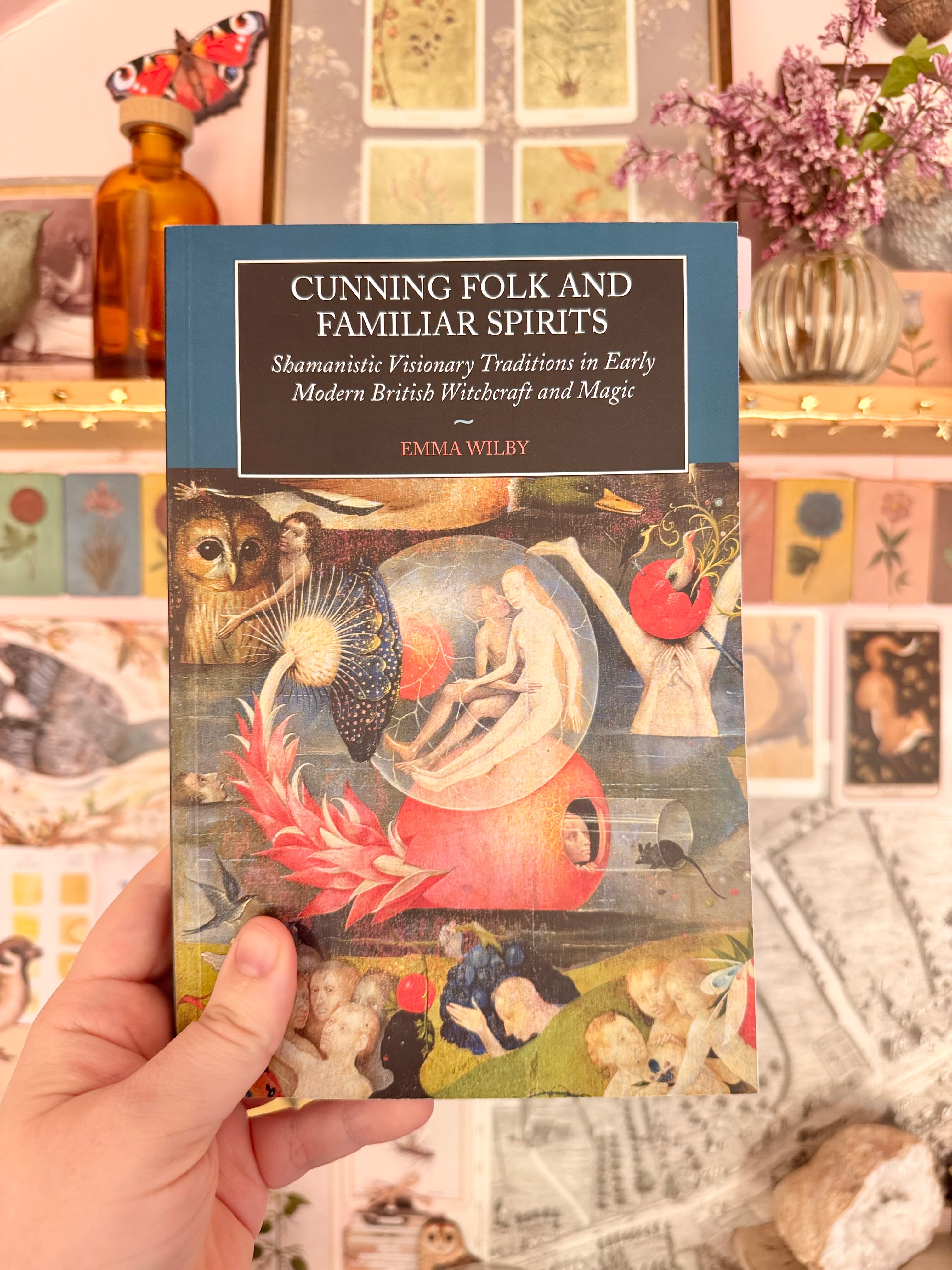
In the context of British practice we can turn to Emma Wilby’s fantastic book ‘Cunning Folk and Familiar Spirits’ (a must have for any research-led/history-obsessed witch). Wilby describes close working relationships between practitioners and familiar spirits (animal guides, the dead, faeries, etc) she argued that these accounts were not fictitious tales drawn up by prosecutors but existed as genuine folk beliefs and lived experiences of the accused. These were also pre-christian and animistic in understanding and, as far as the practitioners were concerned, as real as can be.
How Did They Do It?
So historical records are telling us that people across centuries, continents, and cultures were getting into trances, leaving their bodies, meeting with familiars, and journeying to another place. But how?
Percussion:
Drumming, banging, tapping, the act of making beats or rhythms appear over and over in so many cultures, and appear in places from Siberia all the way to Native America. The science behind percussion being used to alter consciousness is well documented, sustained rhythmic drumming kept at frequencies between four and seven beats per minute shifts brainwave activity, encouraging these slow waves that tip the brain into something called hypnagogia, this is the space between wakefulness and sleep where brain activity closely resembles REM sleep, and where research has shown that blood flow is directed to areas where movement and decision are observed.
Plants:
Accounts of flying ointments have cropped up in historical documents including witch trial accounts, medicinal recipes, and occult workings. In 1428 an alleged Italian witch called Matteuccia de Francesco was burned at the stake after confessing to have flown to a tree as a fly on the back of a demon, she said her ointment was made with the blood of children which she drank… but I type this with great doubt as she was tortured terribly, and the account was taken straight from what her investigator insisted that witches do.
In Johann Weyers 1563 work ‘Praestigius Daemonum’ he argued that flying ointments were not magickal potions, but rather powerful psychoactive drugs, he noticed that these topical ointments were often said to consist of toxic plants from the solanaceae family such as belladonna. When applied to the skin the alkaloids in the plant (scopolamine, atropine, hyoscyamine) cause vivid hallucinations and out-of-body sensations such as floating or disassociation. When we think of belladonna we think of death and rightly so, when ingested this plant is incredibly poisonous, but we now know that the skin can sometimes absorb what the stomach would not be able to tolerate or process without killing us.
I am not recommending that you use ANY poisonous plants, these plants can and most likely will kill you in an incredibly painful way, I have mentioned them purely to make a historical and skeptical point which is that people smearing poisonous ointments on their skin were like tripping balls. However, the hedgerow has always contained poisons and medicines, and as a witch we should definitely learn the distinction. There are plants that were and are safe and even good for your health and your magick, and can help you slip into the hypnagogic state that I mentioned earlier. This is a state that even medieval Christian mystics have documented, such as Julian of Norwich who said she received her revelations in a state she described as hovering between life and death, neither fully conscious, nor gone.
I would argue that you don’t need anything physical to help you travel, it does help enormously, but often just being able to hold yourself at the edge of sleep is enough.
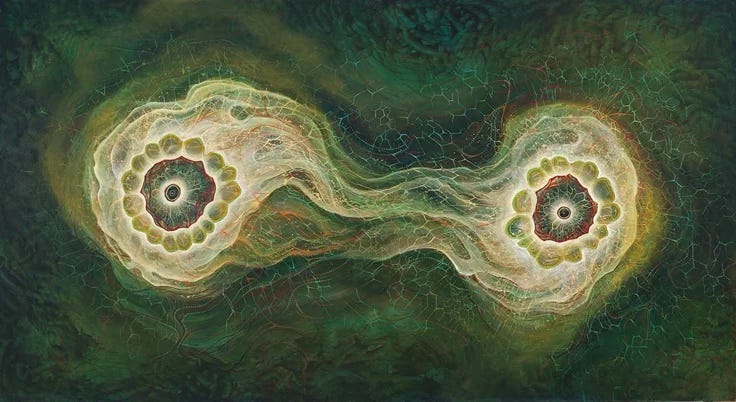
The Otherworld
What did people expect to find there?
Different cultures have documented the Otherworld in different ways, Nordic practices offer Yggdrasil, an enormous world tree with nine realms including various spirit worlds full of elves, dwarves and the dead, this is a place where your fate was weaved and you travelled via the great tree’s branches.
It is in Celtic lands where we get the term ‘Otherworld’, it is a place accessible through liminal magickal spaces such as hedges, hawthorn trees, faery rings, ancient welsh woods, and burial mounds. In Ireland it is forbidden to build upon or near some of these sacred places for fear of upsetting the fae, the fair folk.
These traditions differ in the geography but they are all humming along to the same tune, there exists a different world alongside the one we know where souls live, non-humans, animals and travellers, just like you and I, roam. These places require guides, demand respect, and look down upon those who enter arrogantly, or carelessly, but in return it rewards relationships with spirit guides and a unique perspective that I have yet to find elsewhere.
Thank you for sitting through that lecture, I hope the extra historical context helps you to understand your hedge riding roots a bit more, but now lets move on to what you are most likely here to learn… how to actually do it!
